
Is DIN935 Hex Slotted Castle Nut Carbon Steel Anti‑Loosening Fastener Suitable For Vibration‑Heavy Machinery?
DIN935 Hex Slotted Castle Nut Carbon Steel Anti‑Loosening Fastener is a professional mechanical locking component produced following DIN 935 European industrial standard. Heavy‑duty machinery, agricultural equipment, truck chassis and off‑road transport assemblies frequently suffer from nut loosening caused by continuous vibration, cyclic shock load and alternating stress. Many design engineers and project procurement teams search for reliable physical locking solutions to avoid unexpected equipment downtime, component failure and high maintenance costs for industrial projects. Traditional friction‑relying locking solutions often fail under long‑term cyclic working conditions.
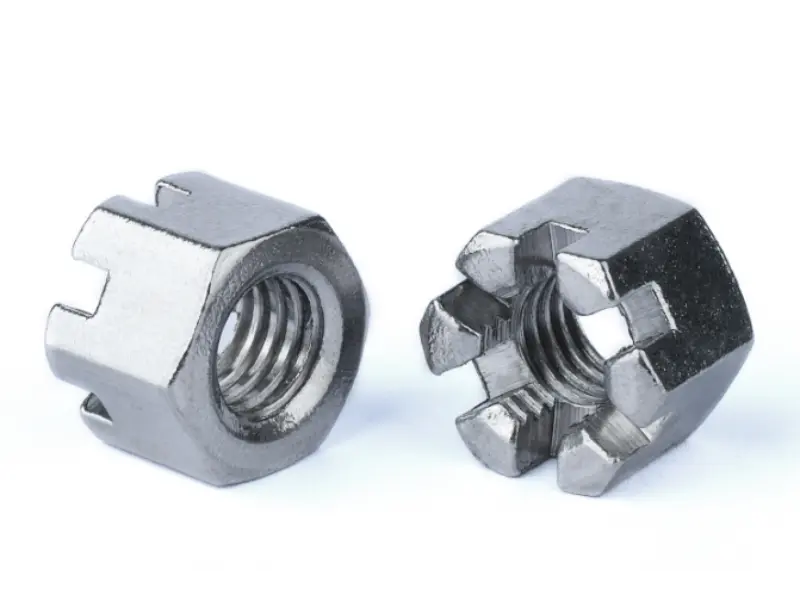
Raw Material & Core Technical Parameters
Raw material selection determines the overall service life and mechanical stability of industrial fasteners. C45 medium carbon steel serves as the primary blank for DIN935 Hex Slotted Castle Nut Carbon Steel Anti‑Loosening Fastener. This carbon‑steel grade provides qualified tensile strength, yield strength and hardness to meet the mechanical requirement of castle nut slot stamping and thread processing. Raw‑material incoming inspection will be performed before mass production to eliminate unqualified steel bars. Multiple surface finish choices are available for different working‑environment corrosion resistance demands, covering zinc plating, black oxide and plain raw finish. Each surface treatment follows corresponding industry coating specification.
|
Item |
Specification |
|
Standard |
DIN 935 |
|
Material |
Carbon Steel C45 |
|
Surface Treatment |
Zinc Plated / Black Oxide / Plain |
|
Locking Method |
Cotter Pin Mechanical Locking |
|
Thread Range |
M6‑M48 |
|
Tolerance Class |
6H Thread Tolerance |
|
Matching Accessory |
Cotter pin, bolt with pin hole |
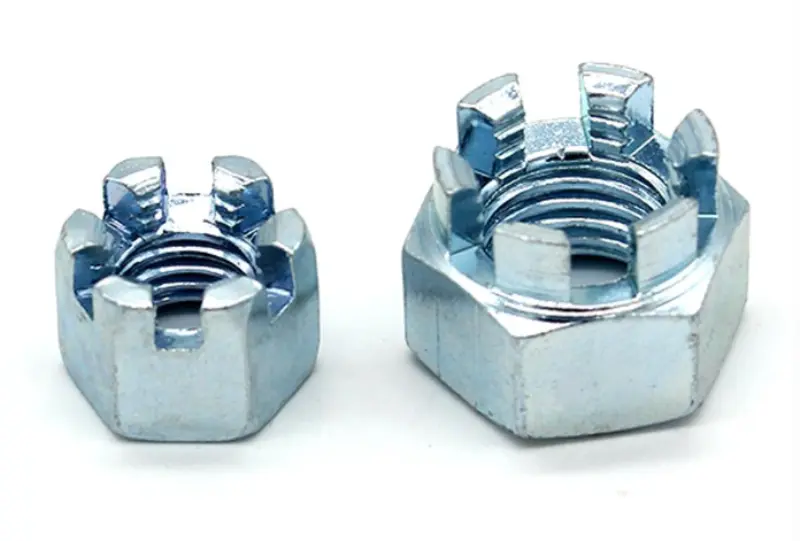
Performance Comparison With Other Common Lock Nuts
Numerous procurement customers mix up castle‑style locking nuts with standard hex nuts, self‑locking nuts and nylon insert lock nuts. A clear performance reference table helps buyers distinguish component features before placing formal purchasing orders and prevent wrong‑model selection for critical assembly positions.
|
Fastener Model |
Locking Principle |
Anti‑Vibration Performance |
Requirement For Matching Parts |
Working Temperature Limit |
Reusability |
|
DIN935 Hex Slotted Castle Nut |
Cotter pin physical interlock |
Excellent |
Need cotter pin & bolt with pin hole |
‑40℃ ~ +250℃ |
Reusable(Replace cotter pin) |
|
DIN934 Plain Hex Nut |
Thread friction only |
Poor |
No extra accessory |
‑40℃ ~ +300℃ |
Reusable |
|
DIN6926 Nylon Insert Lock Nut |
Nylon insert friction lock |
Medium |
No extra accessory |
‑40℃ ~ +120℃ |
Limited reuse times |
The above comparison table reflects core differences between ordinary hex nut and DIN935 Hex Slotted Castle Nut Carbon Steel Anti‑Loosening Fastener. Friction‑based nuts may gradually back off under long‑time vibration, nylon‑insert lock nuts will lose locking performance under high‑temperature environment, while the pin‑locking structure prevents rotation displacement from happening without temperature‑sensitive polymer parts. This feature makes the castle nut widely adopted within vehicle chassis, construction machinery and heavy‑duty machinery assembly projects where safety connection is highly emphasized.
Packaging, Shipment & Logistics Protection
Qualified packaging and shipment operation protect surface condition and thread integrity of DIN935 Hex Slotted Castle Nut Carbon Steel Anti‑Loosening Fastener during long‑distance ocean transportation and multi‑times handling. Standard packing adopts inner moisture‑proof plastic bags plus outer double‑wall corrugated carton boxes. Anti‑rust paper and desiccant bags will be added for zinc‑plated goods to avoid oxidation and rust spot during sea freight in humid maritime environment. Carton marking can support customer‑specified marks, including part number, quantity, batch number, production date and custom shipping marks. Pallet loading with stretch film wrapping is optional for large‑volume orders to facilitate container loading and unloading work and reduce cargo damage risk. Sample order packing can be arranged for pre‑production evaluation requirement.
Manufacturing Process And Quality Control
Our factory owns complete production and quality‑control workflow for fastener manufacturing, covering raw material incoming test, hot forging, thread tapping, slot machining, surface treatment and finished‑goods inspection. Every batch of DIN935 Hex Slotted Castle Nut Carbon Steel Anti‑Loosening Fastener goes through thread inspection, slot dimension checking, hex size measurement and hardness testing before packing. Material test reports and batch inspection certificates can be supplied for project‑based purchasing requests for engineering‑level projects.
Strict dimensional inspection is essential for high‑reliability locking fasteners used on safety‑related assembly points. Slot width, thread tolerance and hex size of DIN935 Hex Slotted Castle Nut Carbon Steel Anti‑Loosening Fastener will be sampled according to DIN 935 standard tolerance range. Thread gauges and calipers are adopted for batch inspection. Unqualified goods will be eliminated before entering packaging procedures to guarantee batch consistency for overseas customers. Third‑party inspection support is available when customers require independent verification.
Frequently Asked Questions For Purchasers
Q: What accessories must be matched when installing DIN935 Hex Slotted Castle Nut Carbon Steel Anti‑Loosening Fastener?
A: The matching cotter pin and bolt with pin hole are mandatory. Only installing the nut alone cannot achieve anti‑loosening function.
Q: Can this product work in high‑humidity outdoor environment?
A: Select zinc‑plated surface treatment for outdoor scenarios, to improve corrosion resistance performance of DIN935 Hex Slotted Castle Nut Carbon Steel Anti‑Loosening Fastener.
Q: Which industries commonly adopt this DIN 935 standard nut?
A: Construction machinery, agricultural machinery, truck chassis and transmission‑related assembly widely adopt this mechanical locking fastener.
Q: Is it allowed to reuse this nut after disassembly?
A: DIN935 Hex Slotted Castle Nut Carbon Steel Anti‑Loosening Fastener itself can be reused, but the matched cotter pin must be replaced with new one for every installation.
Send Inquiry


X
We use cookies to offer you a better browsing experience, analyze site traffic and personalize content. By using this site, you agree to our use of cookies.
Privacy Policy